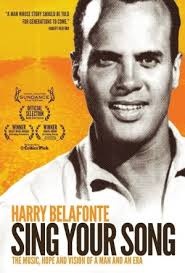
HARRY BELAFONTE: SING YOUR SONG
US, 2011, 104 minutes, Colour.
Directed by Susanne Rostock.
An important documentary on the life of singer, actor, significant 20th century activist, Harry Belafonte. It was produced by his daughter, Gina Belafonte, and released in 2011 when he turned 84. He still had another 12 years of life.
Fortunately, there is an extraordinary amount of material for incorporation into this documentary, background footage of New York in the 20s, 30s and 40s, theatrical material, clips from movies, television footage, interviews… And, close-up commentary from Belafonte himself throughout the film, personal reflections.
He was born in New York City, a broken home, work as a janitor, invited to the American black theatre, finding his ability to act and sing, advised by Paul Robson to “sing your song”.
With the personal narration, the audience is invited not only into his life and his career, but into his passion and activism.
For movie fans, there are clips from his films, especially the buildup to Carmen Jones.
For television fans, there are many excerpts from his appearance on television, and a wide range of performances of his many songs. He was promoted by Ed Sullivan and challenged Sullivan on promoting African-American stars. On tour in the south, he bonded with Marge and Gower Champion despite criticisms of shared stage and touching. This also happened in the 60s when singing with Petula Clark on television, she held his arm, upsetting the sponsors and the networks and audiences, Petula Clark taking a firm stand for Belafonte.
In the 50s and 60s, Harry Belafonte was well aware of race issues and these are visualised in footage from the period, his meeting with Martin Luther King and the continued friendship, supporting him with the March on Washington, getting many film personalities in support, Marlon Brando, Paul Newman, James Garner… As well as performers like Nina Simone.
The Kennedy period is particularly interesting with the March on Washington but also the attitudes and behaviour and discussions with John F. Kennedy as well as Robert Kennedy – and then, 1968, and the impact of the assassinations of Martin Luther King and Robert Kennedy.
And 1968 was significant with the pre-election conventions, Chicago, the Chicago Seven, riots and demonstrations… As well as the attitude towards Vietnam and protests.
Belafonte became very aware of Africa, taking groups of politicians and media personalities on tour and discussions of their effect. He promoted South African singers. And, in the 1980s, with We the People, concern about famine and start visualising of this in Ethiopia. Later he was to be a friend of Nelson Mandela.
There are some insights into his family life, three wives, interviews with some of them, and interviews with his children. Then, his marriage to photographer, Pamela, late in life. And also causes in other countries, like Haiti.
The film ends in 2011 but, as indicated, Harry Belafonte had another decade of life and activity.