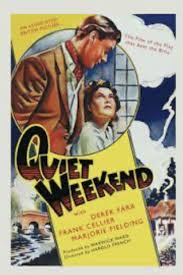
QUIET WEEKEND
UK, 1946, 90 minutes, Black-and-white.
Derek Farr, Frank Cellier, Marjorie Fielding, George Thorpe, Barbara White, Helen Schingler, Edward Rigby, Josephine Wilson, Judith Furse.
Directed by Harold French.
Quiet Weekend is typical of many of the small-scale British comedy dramas after the end of World War II. It is based on a play, while a lot of the action is outside, there are many conversations and interactions. It is interesting in retrospect that there is no mention of the war experience. It is the taken for granted life of the village from earlier in the 20th century continuing on.
There is the atmosphere of the countryside, a group of city people coming to a country home for a gathering and a happy weekend. Marjorie Fielding is strong as the matriarch, organising everything, shrewd in her observations, offering advice. By contrast, George Thorpe as her husband, is gracious, but wanting to spend more time with his good friend, the justice of the peace, Adrian, played by Frank Celier. (Cellier was a character actor who died in 1948 but audiences will remember the long career of his son, Peter Cellier, who resembles his father in appearance, facial features, and acting style.). There is the younger generation, Denys, Derek Farr, persuaded to go to Hollywood to be a private secretary instead of an actor, a wealthy and stylish patron, Rowena, Helen Shingler, who upsets the 18-year-old, Miranda, Barbara White, who has had a long crush on her cousin.
There are ordinary things for weekend in the country, everybody arriving, the friends and associates at the meal, the justice of the peace and his friend and their bets about fishing, the justice concerned about the law and propriety, yet the going poaching salmon, along with Miranda, aided by the chief local poacher, Sam, Edward Rigby. And the police pursuit.
The filmmakers are obviously on the side of the family going to the country and while they present the glamour and wealth of the socialite party, there is more than a touch of satire and criticism.
But it is the older generation the keeps audience attention rather than the problems of Denys and his career and romance.
The film was directed by Harold French, long time director of films and television from the 1930s to the 1950s.