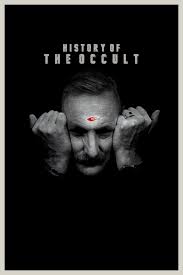
HISTORY OF THE OCCULT. Historia de lo oculto.
Argentina, 2020, 82 minutes, Black-and-white, colour.
German Baudino, Nadia Lozano, Hector Ostrofsky, Agustin Recondo, Ivan Ezquerre, Casper Uncall, Lucianon Guglielmoni.
Directed by Cristian Ponce.
A film for a specialist audience. Of more particular interest to an Argentinian audience with its setting and issues.
With a prologue, a murder, a watchman coming across the murderer, taking his notebook, but later being killed, the rest of the film takes place over a couple of hours, focusing on a particular television program, the Hour Before Midnight. The film is in stark black-and-white, two moments where the colour red is seen by some characters – and a brief final sequence in colour.
The audience has to pay particular attention to the characters and issues, gradually appreciating the complexities of the plot. There is a political background, an election, the candidacy of the president, Belasco, and a group wanting his defeat. They have evidence that he was involved during his university years with a man who claimed to be a warlock, establishing a business company and its thriving, but the ultimate suggestion that it was in fact a coven.
The film focuses on four of the producers of the program, news that it is being terminated because of lack of sponsorship and political critics. This is its last program. The host of the program has been briefed by the producers, three guests invited, a plan for the interviews, the hope for a gradual revelation about the warlock, the coven, the President’s involvement. Behind the scenes there is anxiety, touches of espionage, a secret package from a noted sponsor, a young woman as a lookout outside the studio.
While the program goes generally to plan, with some commercials, with some static and interruption, one of the producers has drugs from the sponsor that they should take in order to deal with the stress of the program and the expose. It has various effects on each of them.
Interviewed is a senator from the government and a question is raised about his knowledge of his daughters, having given one of them away. He storms off the set. The second interviewee is the warlock, confidently and gradually giving all the information to the television host and audience about his being a warlock and the company. The third guest is an author, who has written an expose.
There is pressure at the end, the program coming to an end, a few more minutes, but then a phone call of the warlock to his daughter (allegedly he didn’t have one) and his change of heart, revelations and his wanting to save her.
It is over to the audience then to appreciate this as a drama with a touch of the occult. And, for the audience to consider this in the context of Argentinian political history.